
About Geriatric Psychiatry





What is Geriatric Psychiatry?
Geriatric psychiatry is a specialty focused on preventing, evaluating, diagnosing, and treating emotional and mental disorders in older adults.
Geriatric psychiatrists are psychiatrists that specialize in the diagnosis, care, research about, and treatment of mental conditions affecting older adults. The specialized field of geriatric psychiatry is also commonly referred to as geropsychiatry, geripsych, geri-psychiatry, or psychogeriatrics. Geriatric psychiatrists provide care to their patients in a wide variety of settings, such as private practice, hospitals, assisted living facilities, in-patient care centers, and veteran care centers.
A Rising Need for Geriatric Psychiatrists
The need for geriatric mental health expertise in the United States has never been greater — and the gap between need and available care continues to widen.
At least 5.6 to 8 million older Americans — nearly 1 in 5 — live with one or more mental health or substance use conditions. Depressive disorders and dementia-related behavioral and psychiatric symptoms are among the most prevalent, and many of those affected are also managing multiple chronic conditions that complicate both treatment and caregiving. As the Institute of Medicine (IOM) made clear in its landmark report, The Mental Health and Substance Use Workforce for Older Adults: In Whose Hands?, without a significant and sustained effort to grow this workforce, millions of older adults will face serious barriers to diagnosis and treatment.
The demographic picture makes urgency unavoidable. The U.S. population age 65 and older is projected to grow from 40.3 million to 72.1 million by 2030. Yet today, there are only 7,029 certified geriatricians in the country — roughly half of what is currently needed — and that number is declining. The shortfall in geriatric psychiatry specifically is just as acute.
The IOM has called for a multi-pronged response, including redesigned Medicare and Medicaid payment structures to ensure coverage of counseling and care management, updated accreditation standards requiring all clinicians who treat older patients to recognize signs of mental health and substance use conditions, and a national effort to build a workforce commensurate with the scale of need.
AAGP is committed to that effort — training the next generation of geriatric psychiatrists and advancing the science and practice of mental health care for older adults.
Sources: Institute of Medicine, The Mental Health and Substance Use Workforce for Older Adults: In Whose Hands? (2012); American Geriatrics Society; Alliance for Aging Research.
Considering a Career in Geriatric Psychiatry?

Training
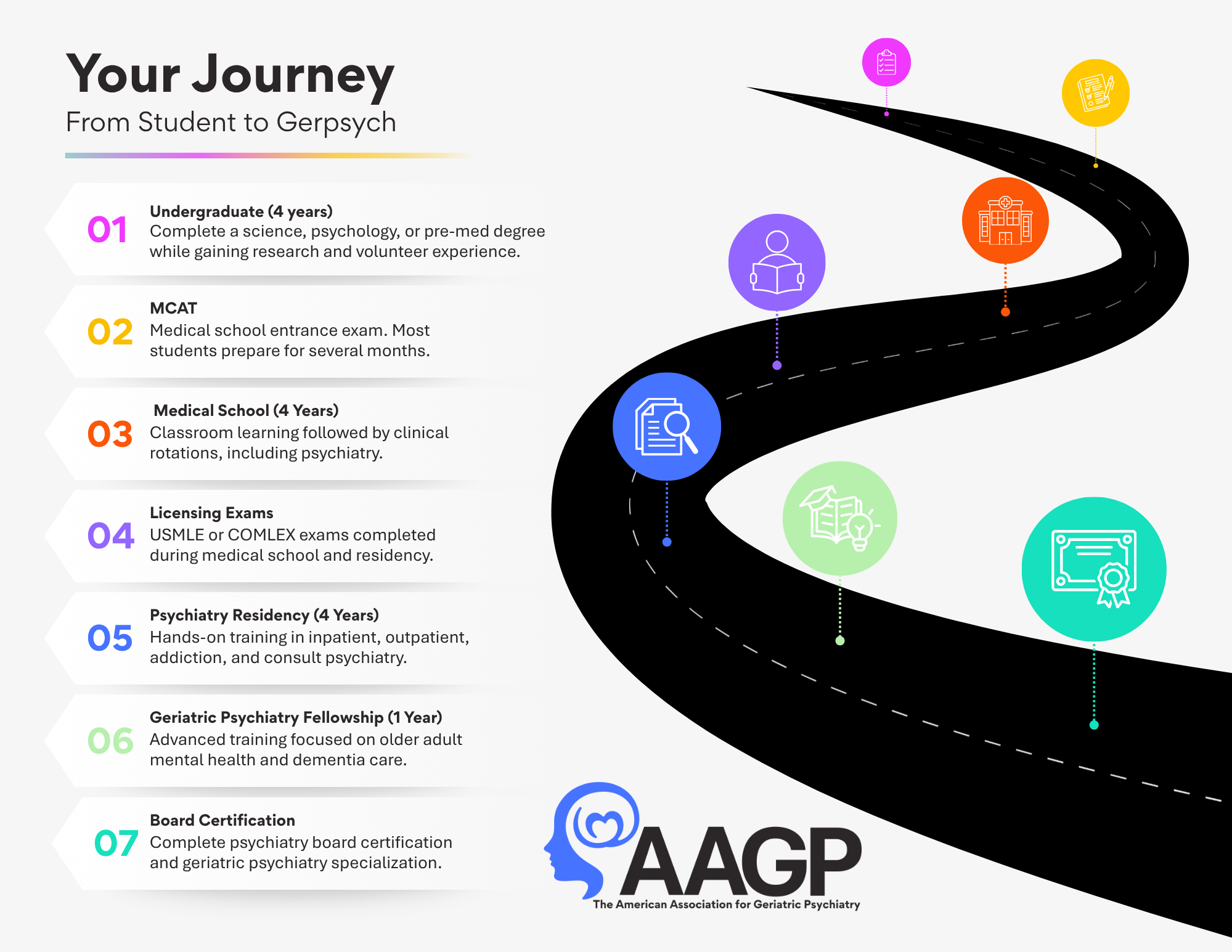
Geriatric psychiatric training requires 4 years of medical school, 4 years of approved residency training in general psychiatry, and 1 year of specialty fellowship training in psychiatric work with older adults in an accredited residency in geriatric psychiatry.
Keep Reading
In the general psychiatry training years, the physician achieves competence in the fundamentals of the theory and practice of psychiatry. In the geriatric psychiatry training, the trainee acquires a thorough knowledge of specific body of scientific knowledge about aging and mental health including patient care, medical knowledge, interpersonal and communication skills, practice-based learning and improvement, professionalism, and system-based practices.
To find a list of accredited geriatric psychiatry fellowship programs, please visit the Accreditation Council for Graduate Medical Education website.

Certification
When the psychiatry resident has completed their geriatric psychiatry fellowship and successfully passed the certification examination in general psychiatry given by the American Board of Psychiatry and Neurology (ABPN), they are eligible to take the additional certification examination in the subspecialty of geriatric psychiatry.
Keep Reading
Although the ABPN examinations are not required for practice, they are an assurance of excellence and an indication to patients and employers of expertise in geriatric psychiatry.
For more information on certification in geriatric psychiatry, please refer to the American Board of Psychiatry and Neurology, Inc. website.
"Members of the American Association for Geriatric Psychiatry who have received their subspecialty certification report a higher salary level than those who have not sat for and passed the certification exam."
- AAGP MEMBERSHIP SURVEY, 2003
Career Satisfaction
"Physicians who specialize in the treatment of children, newborns, the elderly, and skin disorders and who practice in the New England and West Central regions of the country are more satisfied with their careers than their colleagues in other specialties and regions."
- Researchers at UC Davis School of Medicine and Medical Center
August 2002
"In a national survey of fellows who had trained in geriatric medicine and psychiatry, the vast majority of former fellows expressed satisfaction with their current work. Satisfaction with a career choice in geriatrics was significantly greater among those physicians who had practices with large numbers of patients over 75, accepted Medicare assignment, spent their time as clinician-researchers, and had a medical school appointment."
- Siu, Al; Beck, JC; UCLA Department of Medicine
1990 Career Development Opportunities in Geriatric Psychiatry
"In fact, a recent study found that geriatric physicians were more likely to have very high career satisfaction than physicians from 32 other specialties."
- Archives of Internal Medicine
July 2002
AAGP Mentoring/Training Programs
The American Association for Geriatric Psychiatry (AAGP) has several programs for medical students, residents, and fellows for the purpose of increasing exposure to and interest in geriatric psychiatry. These programs have been very successful in that students, residents, and fellows have had the opportunity to be mentored by senior geriatric psychiatrists, attend the AAGP Annual Meeting, receive the scientifically peer review journal, the American Journal of Geriatric Psychiatry, among other benefits and programmatic components. For the latest information on available AAGP mentoring/training programs, please visit www.AAGPonline.org/scholars.
NIH Research Loan Repayment Program
The National Institutes of Health offers Loan Repayment Programs to attract health professionals to careers in clinical, pediatric, health disparity, or contraceptive and infertility research. In exchange for a two or three-year (for Intramural General Research) commitment to your research career, NIH will repay part of your qualified educational debt. In addition, the NIH will make corresponding Federal tax payments for credit to your Internal Revenue Service tax account that you incur as a result of your LRP benefits. For more information, visit the NIH website at www.lrp.nih.gov.